Pregnancy and complications
Introduction to pregnancy complications and the possible relationship with brain injury
High blood pressure (hypertension) is a common problem that may affect the health of both the mother and the baby. This can range
from mild forms to more serious conditions.
Complications of hypertension pressure during pregnancy can cause problems with thinking as well as damage to the brain. Pressure can build up in the cerebral blood vessels. There is also a risk of thrombosis (blood clots) during or just after pregnancy, which is related to hormones. These blood clots can cause a stroke or sinus thrombosis.
On this page, we delve deeper into the different forms of high blood pressure during pregnancy and the various complications that can arise.
We also discuss the possible consequences for the mother's brain and the child's brain. Fortunately, this does not occur in everyone. We also mention the possible consequences for a premature baby.
Different types of high blood pressure during pregnancy
Complications of high blood pressure (hypertension) in pregnancy may lead to cognition problems and brain damage. There are different forms of high blood pressure in pregnancy and there are different complications that can arise.
The different forms:
- Pregnancy hypertension: high blood pressure in the second half of pregnancy without the loss of protein in the urine;
- Preeclampsia: high blood pressure with protein loss in the urine in the second half of the pregnancy. In the Netherlands the general name for this form is the Dutch word for: pregnancy poisoning;
- Chronic hypertension: high blood pressure that existed before pregnancy or that was discovered in the first trimester;
- Superimposed pre-eclampsia: a pregnant with chronic high blood pressure that develops pre-eclampsia in the second half of pregnancy.
In addition, the following complications can arise in all women with one of the above forms. (However, this is most common in women with (superimposed), pre-eclampsia):
- HELLP syndrome: different organs are affected by this syndrome, causing breakdown of red blood cells, liver damage with elevated liver enzymes and clotting problems in the form of too low numbers of platelets;
- Eclampsia: the brain is affected by the high blood pressure causing seizures or convulsions to occur and, in some cases, loss of consciousness.
The relationship between these disorders
Hypertension (high blood pressure) is the most common condition during pregnancy and can have serious consequences for mother and child. HELLP syndrome is usually associated with preeclampsia but can also occur without hypertension.
Eclampsia is usually preceded by pre-eclampsia, but it may be that pre-eclampsia was previously undetected or mild. The sooner the pre-eclampsia or complications arise in the pregnancy, the more serious the course usually is.
All forms of pregnancy complications can arise before, during or after delivery. Treatment of any form of preeclampsia, HELLP syndrome and eclampsia belongs in a hospital. The treatment will vary per condition but generally consists of blood pressure lowering medication, magnesium sulfate, pulmonary medication for the unborn child and the introduction of delivery.
A complication that we do not discuss here but that can occur in pregnancy due to disturbed blood clotting is sinus thrombosis.
What is pregnancy poisoning (pre-eclampsia)?
Pre-eclampsia is a complication that may occur during pregnancy and is characterized by high blood pressure and protein in the urine.
It usually develops after the 20th week of pregnancy and can have serious consequences if not recognized and treated in time. However, it can also occur earlier in the pregnancy.
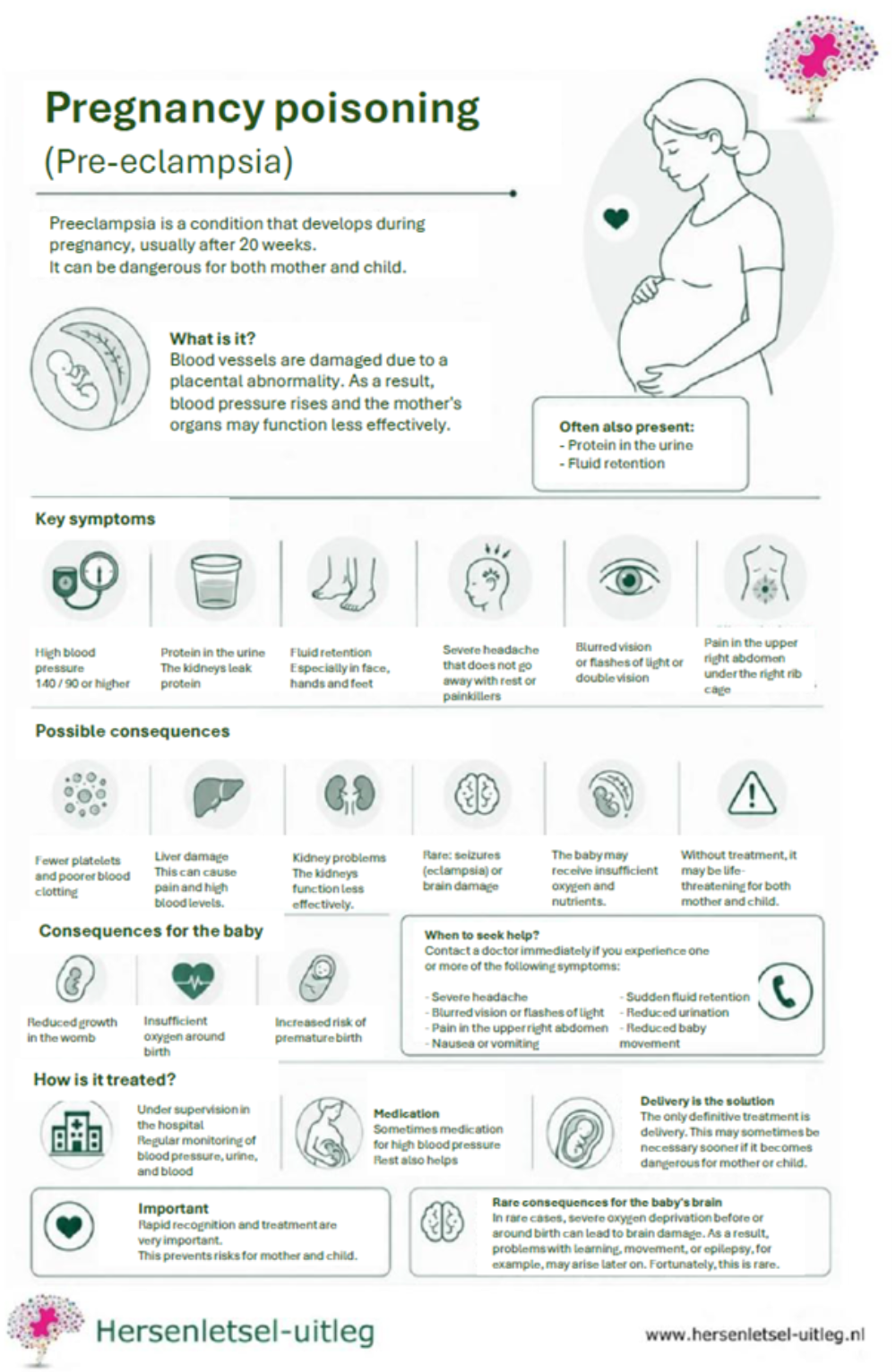
The exact cause of pre-eclampsia is not yet fully known, but it is likely related to abnormalities in the development of the placenta.
A woman can also develop pre-eclampsia in the days following delivery.
Symptoms that may occur:
(Please note! Women with pre-eclampsia do not always have all of these symptoms, but only a combination of them.)
- persistent headache
- fluid retention (edema) in the face, hands, lower legs, feet, and organs. This results in swollen ankles, a puffy face, and swollen hands with a tingling or stinging sensation. The body retains fluid.
- rapid weight gain
- fatigue
- nausea and vomiting
- blurred vision or seeing stars, double vision, flashes of light, or spots
- pain in the upper abdomen and upper back
- a flu-like feeling
- the sensation of a tight band around the abdomen (also known as the ‘band feeling’)
- high blood pressure
protein in the urine (These proteins are caused by kidney damage due to high blood pressure. - other signs of temporary organ damage. The liver and blood vessels can be damaged, which can lead to fluid retention and blood clotting problems.
- high blood pressure can cause the placenta to function less effectively. As a result, the baby receives fewer nutrients.
Please note! Swelling of the hands and feet also frequently occurs in women who do not have high blood pressure!
For the mother, pre-eclampsia may lead to a more severe form such as eclampsia (with severe seizures), organ damage, or HELLP syndrome. For the child, it can limit growth or cause premature birth.
There can sometimes also be long-term consequences for the brains of the mother and the child. Read here about the possible consequences for the mother's brain.
Read here about the possible consequences for the child's brain.
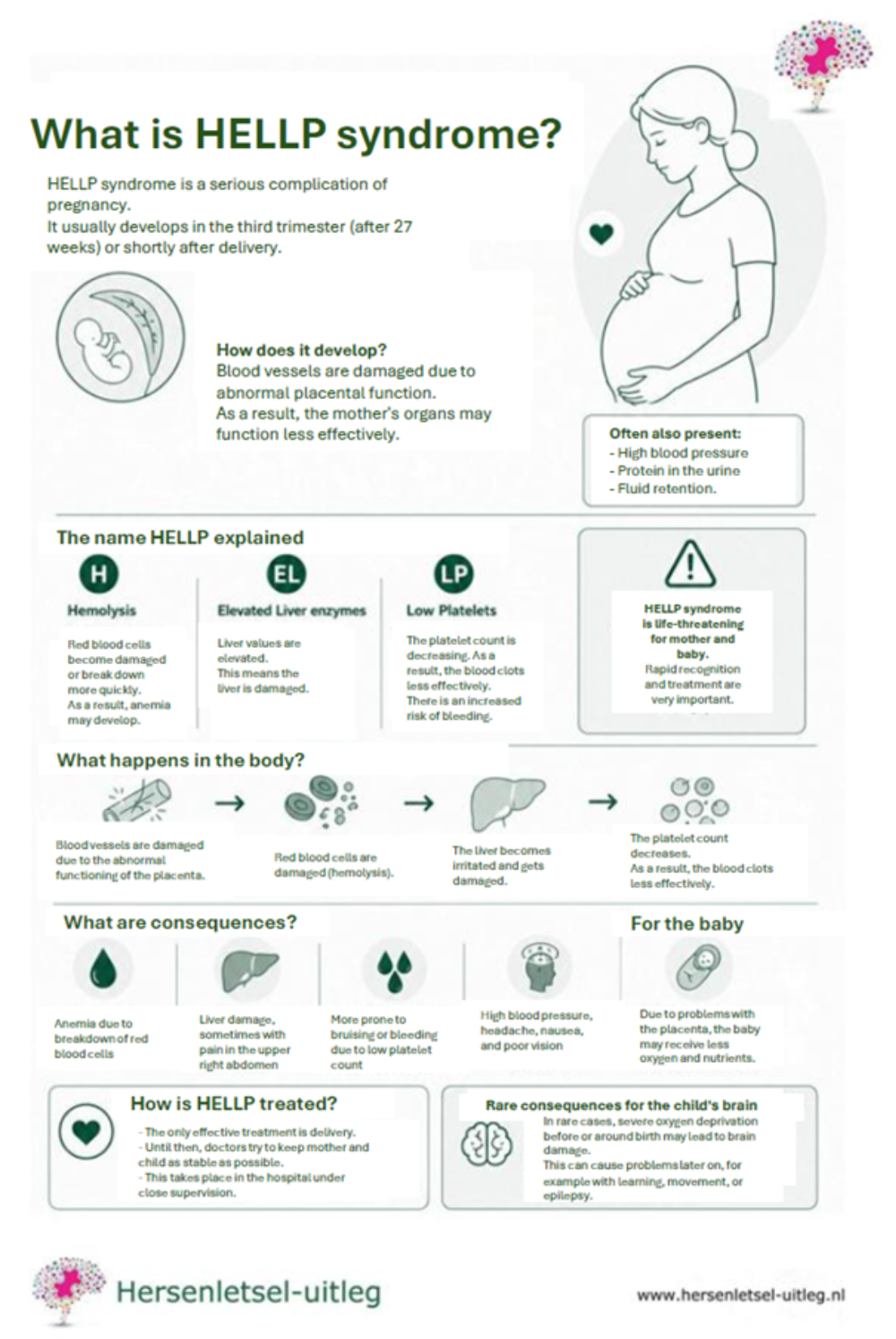
The meaning of the abbreviation HELLP
- H Hemolysis = breakdown of red blood cells
- EL Evelated Liver enzymes = increased liver enzymes; disturbed liver functions
- LP Low Plateles = reduction in the number of platelets in the body; thrombocytopenia.
The symptoms of the HELLP syndrome
Symptoms that may be associated with high blood pressure and HELLP syndrome are:
- initially a flu-like feeling
- fatigue
- fluid retention / edema, particularly in the hands, feet, and face, leading to rapid weight gain
- a feeling of tightness (a tight band around the abdomen)
- nausea and vomiting
- concentration problems
- headache
-
vision problems such as blurred vision, seeing flashes of light, or spots
-
severe pain in the upper abdomen or under the breast/stomach pit (typical of HELLP syndrome)
-
pain in the upper back or between the shoulder blades
-
tingling (for example in the fingers) due to fluid retention / edema
-
infrequent urination / urine appears brownish (in a later stage)
-
possible neurological complications such as a brain hemorrhage
swelling of the brain (brain edema) -
PRES, which is the abbreviation for Posterior Reversible Encephalopathy Syndrome. It is characterized by headache, vision problems, decreased consciousness, and epileptic seizures. An MRI scan of the brain often shows edema on both sides of the posterior brain regions.
Read here about the possible consequences for the mother's brain. This rarely occurs and, fortunately, is not the case for everyone.
Read here about the possible consequences for the baby's brain. This rarely occurs and, fortunately, is not the case for everyone.
What is eclampsia?
Eclampsia is characterized by the occurrence of epileptic seizures or convulsions in a pregnant woman with high blood pressure. These are seizures that are not caused by an existing neurological condition.
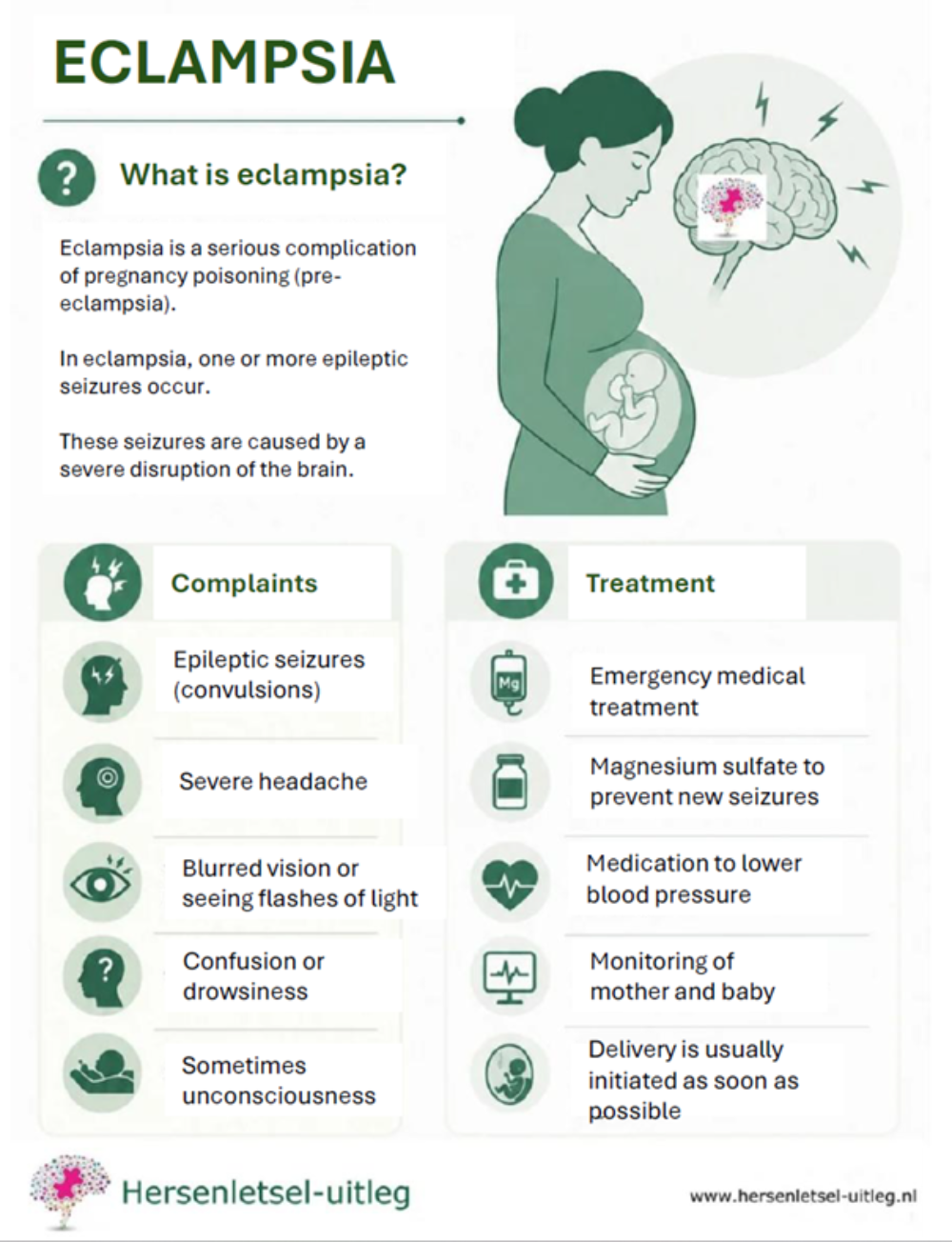
When the blood pressure becomes too high, the brain vessels can no longer cope with the pressure and they start to leak fluid into the brain tissue, which is called edema formation. If the brain tissue becomes too disturbed or oppressed by this moisture, it manifests itself in headaches, blurred vision, spotting, blindness, nausea and vomiting and ultimately in convulsions such as with an epileptic insult.
These convulsions are not an epileptic attack even though it looks like this. It is possible that women bite their tongue and / or lose urine.
They may also experience loss of consciousness or fall into a coma. Women with eclampsia have an increased risk of also experiencing a brain hemorrhage.
The formation of fluid in the brain (cerebral edema) at an elevated blood pressure by which convulsions occur may also occur in people who are not pregnant. Then it is called Posterior Reversible Encephalopathy Syndrome, or PRES.
On an MRI scan, abnormalities are seen in the white matter of the brain, in the area of the parietal lobe and occipital lobe. Encephalopathy literally means sick brain. Reversible means that it is a reversible process if it is treated in time.
The symptoms
Complaints of high blood pressure and HELLP syndrome are:
- Initially flu-like feeling
- Fatigue
- Retaining moisture / edema especially hands and feet and face and thereby rapid weight gain
- Band feeling (tight band around belly)
- Nausea and vomiting
- Concentration problems
- Headache
- Problems with seeing, for example, blurred vision, light flashes or spots
- Severe pain in the upper abdomen or below the chest / stomach pit (typical of HELLP syndrome)
- Pain in the upper back or between the shoulder blades
tingling (for example in the fingers) due to the edema - Little urination, causing the urine to appear brownish (at a later stage)
Read here about the possible consequences for the mother's brain. This rarely occurs and, fortunately, is not the case for everyone.
Read here about the possible consequences for the baby's brain. This rarely occurs and, fortunately, is not the case for everyone.
Consequences for women in later life
Brain abnormalities
In women with high blood pressure due to preeclampsia and eclampsia, small abnormalities appeared in the white matter of the brain.
This has been found on MRI scans a few years after the pregnancies with:
- pre-eclampsia
- HELLP syndrome
- eclampsia
The women who had eclampsia had more of these abnormalities, especially if they had had several attacks of eclampsia.
The women with pre-eclampsia had more abnormalities if they had had pre-eclampsia earlier in pregnancy.
The white matter abnormalities are mainly located in the frontal lobe, followed by the parietal lobe, insula and the temporal lobe.
This distribution does not match the damage caused by the moisture during eclampsia. The idea is that it is not caused by the fluid accumulations during eclampsia, but that the abnormalities are caused by the high blood pressure (hypertension) itself (before, during and / or after the pregnancy) and the increased risk of women with (pre-) eclampsia on the development of cardiovascular diseases (see below).
They are small, permanent brain changes that occur in several circumstances, for example in case of severe migraine, hypertension and old age.
In some cases, the moisture can cause direct brain damage in eclampsia or PRES itself. There are reports on patients who develop permanent blindness (visus problems) or epilepsy, but these are exceptions.
In a large group of women who had experienced eclampsia, the sight was checked and no woman appeared to have permanent visual field disorders.
The white matter in the brain consists of suckers of nerve cells / brain cells. These brain cells themselves form the gray matter. The white color comes from the casing of the nerve suckers that is a kind of protective layer, consisting of myelin. The nerve fibers provide communications between the regions in the brain and the spinal cord.
White matter abnormalities are usually associated with cognitive decline in older people and with the development of dementia. Cognitive disorders as reported by women after (pre-) eclampsia are also associated with the development of dementia later in life. It has been shown that women who have had pregnancies with pre-eclampsia are at increased risk of developing vascular dementia compared with women who have had uncomplicated pregnancies.
Long term deviations
In recent years, large-scale research has made it very clear that women who have had a pregnancy with (pre-) eclampsia have a greatly increased risk of developing cardiovascular disease later in life. This includes high blood pressure, heart attacks, cerebral infarctions, cerebral haemorrhages, thrombosis and pulmonary embolism.
A healthy lifestyle (smoking, no overweight, sufficient exercise and healthy eating) is also advised to all women who have had a pre-eclampsia pregnancy. They are also advised to have their blood pressure checked annually by the general practitioner.
Cognitive abnormalities
As a result of these pregnancy complications, there is a chance that the mother will develop cognitive changes and permanent brain changes later in life. Cognition involves observing, thinking, remembering information and applying and understanding this knowledge in a good way. Memory problems and concentration problems are reported by these women.
For many women, these problems will automatically disappear over time. In a small proportion of women, these complaints persist for a long time. In addition to memory and concentration disorders, post traumatic stress syndrome, (PTSD) and symptoms of depression are also more common. This can strengthen the complaints of memory and concentration loss.
Despite the fact that after eclampsia, pre-eclampsia and HELLP syndrome women report problems with memory and concentration, few abnormalities were found in neurocognitive research. Neither has there been found a relationship between the white matter abnormalities and the degree of cognitive impairment in these women.
In the literature there are reports of non-pregnant patients with PRES in whom clear deviations were found. It appears that pregnant women with eclampsia recover better in the long term than non-pregnant women with PRES. Yet there are some women who experience serious problems after a complicated pregnancy.
Our advice is therefore that in case of persistent cognitive complaints a neuropsychological examination is done, so that injury is discovered and possible help can be offered earlier. Some women benefit from a rehabilitation process.
Consequences for the child's brain
Because the lives of mother and child are at stake in the pregnancy complications mentioned above, the children are born earlier or removed earlier by means of a caesarean section. They are not full-term.
In children born before the seventh month, the brain do not yet have windings or grooves. After the seventh month of pregnancy, the brain surface is significantly enlarged with those grooves and windings.
Immature brain at birth can have consequences throughout life. The child may also be injured by the eclampsia, or the HELLP syndrome of the mother.
Research shows that pre-eclampsia may reduce blood flow to the placenta. As a result, the baby receives less oxygen and nutrients. This can affect the baby's brain development and later lead to a higher risk of learning difficulties, developmental delays, and other problems with the nervous system. The child may experience growth retardation during pregnancy and be born prematurely.
The following problems may occur, but different per child and per situation:
- Delays in brain development
- Oxygen deficiency
- Diffuse injury
- Cerebral palsy / spasticity often one-sided increased tension of the muscles / cramps
- Cerebral hemorrhage due to immaturity of the vascular system sometimes varies in severity with semi-sided paralysis
- Intraventricular brain haemorrhage (blood flows in the brain cavities / ventricles) varying in severity, sometimes with semi-sided paralysis
- Cerebral infarction
- Periventricular leukomalacia PVL (softening of the white matter)
- Cysteuze leukomalacia (small fluid-filled cavities (cysts) in the white matter).
Also read our page about congenital brain injury.
In the last 15 years there has been a decrease in cerebral palsy in premature babies, probably due to advances in the care of very preterm children.
Possible problems with premature children in the long term
- Problems with motor skills
- Cognitive problems / learning problems
- Intellectual problems
- Sensory problems
- Behavioral problems
- ADHD
More information:
https://my.clevelandclinic.org/health/diseases/21637-hellp-syndrome
https://www.nhs.uk/conditions/pre-eclampsia/
advertisements are not ours