Disorder in executive functioning
Executive functions (EF) are the higher control functions of the brain. They control actions and behavior, help set goals and achieve them. They also help keep demands, needs and obligations in balance.
Executive functions include many different processes. "Executive functions" is therefore a so-called "umbrella concept". The executive functions develop from birth to the age of approximately 23 years. This development often takes place in so-called spurts. If a child or young person sustains a brain injury during this period, this has a direct effect on this development and therefore on behavior.
The executive functions can be examined by means of a neuropsychological examination.
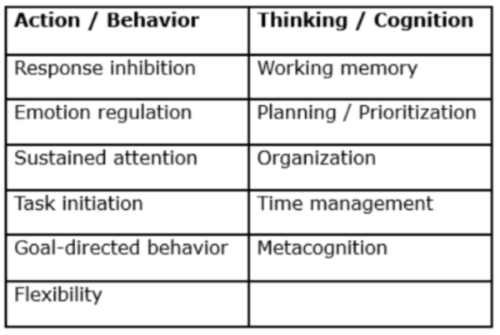
Below is an overview of a number of common executive functions.
- Impulsivity: (Response inhibition) the ability to think before action is taken
- Inhibition: the ability to control an impulse. This also plays an important role in being able to maintain focused attention. (Action / Behavior),
- Emotion regulation: regulate emotions to achieve goals or control behavior. (Planning / Prioritization),
- Targeted behavior (metacognition) (Action / Behavior)
- Flexibility: The ability to adapt to changing circumstances. But also reviewing your plans if obstacles or setbacks arise, new information presents itself or mistakes are made. Problems with flexibility can lead to perseveration. (Action / Behavior)
- Task initiation: The ability to start a task efficiently and without delay. (Action / Behavior)
- Working memory: The ability to keep information in memory when performing complex tasks and to filter between what is relevant and what is not relevant to remember. (Thinking / Cognition)
- Planning: The ability to make a plan, achieve a goal, or complete a task. Decide what is important and what is not. (Thinking / Cognition)
- Organization: The ability to develop and maintain systems to stay up to date with information or materials required. (Thinking / Cognition)
- Persistent attention (Action / Behavior)
- Time management: The ability to estimate time, how much time it will take, how you can best divide the time and how you can work on time. (Thinking / Cognition)
Problems with executive functioning due to brain injury / Executive function disorders
An impairment in executive functioning occurs if (some or more of) the aforementioned functions are no longer possible due to brain injury. Because executive functions play a role in many daily activities, many problems may arise after brain injury.
A number of problems that may occur in someone with a disorder in executive functioning (NB: every injury and every person is different).
- No longer being able to organize activities
- Not knowing where to start
- Inability to maintain focus
- Difficulty with cooking, for example, due to a lack of overview regarding the logical next steps in which order: "how? and how long each cooking time, and with which ingredients or which pans?". Cooking falls under multitasking
- No longer being able to handle changes flexibly (see also perseveration)
- Unable to come up with a new plan in the face of setbacks
- Unable to switch quickly from one task to another
- Unable to figure out the best way to allocate time for a task
- Obsessive behavior (particularly with injury to the frontal lobe or the temporal lobe) such as constantly counting, singing, tapping, or exhibiting the same behavior)
- Having difficulty responding appropriately in social interactions (particularly with injury to the frontal lobe)
- Impulsive behavior (particularly with injury to the frontal lobe)
- Problems with emotion regulation (particularly with injury to the frontal lobe)
- Distractibility, see next chapter
Distractibility due to brain injury
Distractibility, the phenomenon where people find objects in completely inappropriate places, can be a manifestation of brain injury. Distraction is caused by disruptions in the brain functions responsible for memory, attention, and planning.
Memory, attention, and planning are important components of how we can perform and organize things (the executive functions).
This may lead to situations such as finding keys in the freezer or a wallet in the sock drawer, forgetting where you parked the car, restarting the washing machine for the third time without adding the laundry, or finding the phone in the fridge. These clumsinesses are not only frustrating but can also be a sign that the brain is struggling to organize and remember daily tasks.
Memory
Memory is important for how we do things. It helps us remember information and retrieve it when we need it. With brain injury, memory may be severely damaged. This may cause us to forget things or even have difficulty remembering our past.
For example, someone who has sustained a brain injury may have trouble remembering appointments or important dates, which can significantly disrupt his or her daily life.
Attention
Attention is an important part of how we do things. It helps us focus on what we need to do while pushing distractions away. If someone has a brain injury, that attention can diminish. This can lead to problems such as thoughts constantly wandering during a conversation or failing to complete a task.
An example is someone struggling to read a book because thoughts keep drifting.
It may also happen that someone leaves behind a lot of unfinished tasks. While putting the groceries away in the fridge, you notice that the vegetable drawer is dirty. So, a quick clean.
At the sink, you remember that the soap dispenser needs refilling. Meanwhile, the groceries remain lying there disorganized or thawing, while you refill the soap anyway.
Planning
Planning helps us see more clearly what we need to do and how we can achieve our goals. For people with brain injury, making plans may be difficult. This may mean that someone does not know how to approach a project step by step or even just how to structure a day. An example is when someone struggles with organizing a family outing, which may lead to chaos and confusion.
Brain areas involved in executive functioning
Neurophysiological and neurocognitive research shows that executive functions are mainly related to the frontal cortex or the prefrontal cortex. When there is damage to the prefrontal cortex, it is sometimes referred to as a "frontal syndrome". With a frontal syndrome there are often a collection of complaints, including problems with executive functions.
In recent years, new research has shown that deeper brain areas such as the striatum also play a role in executive functions.
The upper part of the corpus striatum consists of the caudate nucleus and the putamen. Brain scans show that the caudate nucleus in the striatum plays a role in tasks related to planning and organizing (executive functions).
Not all problems with executive functioning can therefore be attributed to the (pre) frontal cortex.
Tips to improve your executive functioning
- Schedule demanding tasks at the times when your energy level and alertness are optimal,
- Plan tasks in a simple step-by-step approach,
- Take regular breaks, take a deep breath and make time for physical and mental relaxation. This includes a coffee break, a chat with friends, a nap, or a walk,
- Make use of planning and memory apps (pictogenda, pictoplanner, remember the milk, Assist helps, the work app),
- Take notes and keep them in fixed places,
- Occasionally talk aloud to monitor thoughts and actions,
- Practice different strategies to determine which is the most effective in different situations. Then ask yourself what distracts you and makes your attention drop and note that. Also note what you have to do to make a strategy work. Or what you should do differently next time.
For loved ones it can also sometimes be difficult to know how to deal with someone with a disturbed executive functioning. Below some general tips.
- Try to clearly indicate boundaries and structure,
- Explain plans, tasks and actions well. Sometimes this includes repeating steps,
- Tasks can provoke frustration if it fails. Realize that fear of failure or shame or fear of anger from others can also play a role and give support,
- Avoid discussions and issues, stay calm. Try to stay out of your own emotion and stay out of a power conflict. If things get out of hand, take a time out, then you do not reject the person but you give yourself and the person a moment of rest and distraction. Then try to come back with kindness,
- Ensure peace in the house, also in terms of sounds and other disturbing stimuli. Low-stimulus offers more peace.
Can a person take charge of his or her own life?
Even the most intelligent people with brain injury can struggle with taking control. That is nothing to be ashamed of. One task may be accomplished perfectly, while another is more difficult due to the injury.
What does it mean to take charge?
Taking charge means that you can manage life independently, without help in specific areas. You can make all decisions yourself and bear the responsibility. It is self-reliance on a social, physical, and cognitive level. You can take care of yourself in life. You can organize and manage your own life and household as you wish.
Support in taking charge
As soon as someone gets stuck in a specific area, such as planning or maintaining an overview, for example, they can call upon an individual support worker who is trained to work with people with brain injuries.
This is also referred to as outpatient support. Tailored support, with the goal of taking control of your own life. With respect for an individual's autonomy and with an eye for where support is needed. There is rarely a complete or entirely absent sense of control.
We asked an outreach worker specialized in brain injury to talk about her work. See here.
Your brain is super complex, and sometimes you notice immediately when something isn't working quite right. It is good that you know for yourself what is difficult for you.

advertisements are not ours