Wallenberg syndrome - Lateral medullary syndrome

picture info medulla oblongate see footnotes
Depending on the area that is affected by an infarction in the brainstem, it is called syndrome of Benedict, Claude, Foville, Millard-Gubler, Wallenberg and Weber. Read more....
Wallenberg syndrome (Lateral medullary syndrome)
A stroke in the medulla oblongata, a part of the brainstem, is called Wallenberg syndrome.
It is also known as lateral medullary syndrome, because in medical terms the medulla oblongata is called the lateral medulla.
According to researchers, Wallenberg syndrome can also occur after chiropractic treatment.
The brainstem lies diagonally in front of and below the cerebrum and consists of three parts. The lower part is the medulla oblongata. This part provides the connection between the brainstem and the spinal cord.
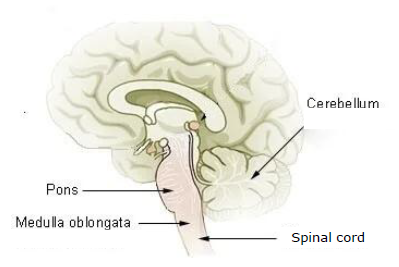
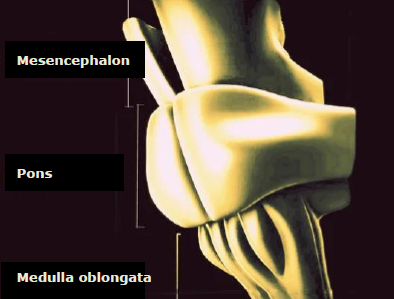
Various cranial nerves that control the muscles of your face and hearing, among other things, originate in the medulla oblongata.
It also houses centers for regulating important bodily functions such as heart rate, breathing, blood pressure, sleeping, and waking. Damage to the medulla oblongata can have serious consequences.
PICA and PICA syndrome
Wallenberg syndrome is caused by a blockage in one of the arteries in the neck, the vertebral artery or the vertebral artery. As a result, a branch of this artery, the posterior inferior cerebellar artery (abbreviated PICA), does not receive enough blood.
The syndrome is also called PICA syndrome. More explanation on our page about cerebral blood vessels.
If a part of the brain does not receive enough blood, the tissue there can be damaged or die. This can happen, for example, in the medulla oblongata.
In this process, the dorsolateral part of the medulla oblongata becomes damaged. Simply put, dorsolateral means on the outside of the back of that area. "Dorso" means back and "lateral" means outside.

Blood vessels with the PICA artery (the Posterior Inferior Cerebellar Artery)
Characteristics of Wallenberg syndrome
- suffer from hiccups
- acute vertigo
- difficulty swallowing
- vomiting
- hoarseness or voice problems
- difficulty speaking clearly / articulating (dysarthria)
- no gag reflex on the affected side
- difficulty walking or coordinating on the affected side (ipsilateral ataxia)
- reduced sense of taste on the affected side
- occasional strange sensation in the soft palate
- pain on one side of the face
- an unpleasant stinging, tingling, or burning sensation (paresthesia)
- reduced sensitivity to pain on the other side of the body (contralateral hypoalgesia)
- reduced ability to sense temperature in the trunk and limbs (thermoanesthesia)
- redness in the face
- dry skin
- less sweating (sometimes actually more)
- double vision (diplopia)
- blinking less often with one eye
- rapid jerky eye movements (nystagmus). See image below.
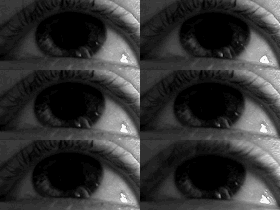 Nystagmus
- sometimes complaints that everything around the person seems tilted or out of balance
- sometimes balance problems
- light sensitivity
- sometimes hemiplegia or loss of strength and sensation (in limbs, the face, or the tongue)
- heart rate slowing (bradycardia)
- high or low blood pressure
- high or low blood pressure
- sometimes ringing in the ears (tinnitus)
- neuropathic pain / central pain syndrome (nerve pain or the central poststroke pain CPSP in Wallenberg syndrome)
- a drooping eyelid (also called drooping eyelid or ptosis) and a smaller pupil (miosis) on the same side and dry skin, no longer sweating (anhidrosis) around the eye or on one side of the face, may indicate Horner's syndrome.
- The classic triad of symptoms of Horner's syndrome includes:
- Ptosis (drooping eyelid)
- Miosis (small pupil)
- Anhidrosis (reduced sweating on the same side of the face)
- The classic triad of symptoms of Horner's syndrome includes:
See image:
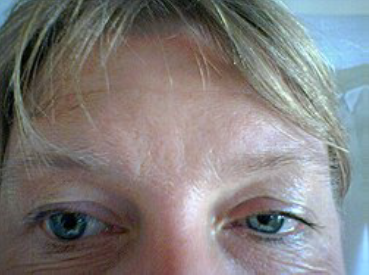
Horner's syndrome

Horner's syndrome can occur in a large number of conditions, in addition to brain injury.
In the case of brain injury, it can occur with:
- Stroke (CVA), especially in the brainstem
- Brainstem injury
- Multiple sclerosis (MS)
- Brain tumor
- Lighter eye color (heterochromia) when the syndrome develops early in childhood
- Reduced reddening of one side of the face during exertion or heat
- Traumatic brain injury
Symptoms of Horner's syndrome:
Eye
- Small pupil (miosis)
- Drooping upper eyelid (ptosis)
- The eye appears to sit slightly deeper in the eye socket (apparent enophthalmia)
Face
- Reduced or no sweating on one side of the face (anhidrosis)
- Sometimes red or warmer skin on one side
Eye reactions
- Delayed pupil dilation in the dark
- Difference in pupil size is particularly visible in a dark environment
In children
- Lighter eye color (heterochromia) when the syndrome develops early in childhood
- Less reddening of one side of the face during exertion or heat
Important to know
Horner's syndrome can be an indication of an underlying condition. Especially when symptoms appear suddenly, this may point to a serious cause, such as a carotid dissection, a stroke, or a Pancoast tumor. Therefore, prompt medical assessment is important.
Nerve pain
A stroke in the medulla oblongata can also cause a specific nerve pain: central post-stroke pain (CPSP) in Wallenberg syndrome / central pain syndrome. This is a neuropathic pain that can be constantly present or intermittently present. The pain is described as numbness, prickling, tingling, severe stabbing, shooting, or burning pain, or a 'freezing' sensation.
Normal touches can also be experienced as painful, as can feeling pressure from clothing or a duvet, or even feeling cold (allodynia).
PLEASE NOTE!
In the event of brainstem injury, it is advisable to check for central sleep apnea syndrome (CSAS) in case of sleep problems and severe fatigue. In this condition, the brain inadequately controls the lungs, particularly during sleep.
Read more about the medulla oblongata, the brainstem or
read more about invisible consequences of brain injury.
advertisements are not ours
Sources
chiropractic manipulation (Caplan, 1986)
Eyskens, E., Feenstra, L., Meinders, A. E., Vandenbroucke, J. P., & Van Weel, C. (1997). Codex Medicus (10eed.). Maarssen, Nederland: Elsevier Gezondheidszorg
Gasca-González OO, Pérez-Cruz JC, Baldoncini M, Macías-Duvignau MA, Delgado-Reyes L. Neuroanatomicalbasis of Wallenberg syndrome. Cir Cir. 2020;88(3):376-382. English. doi: 10.24875/CIRU.19000801. PMID:32539005
Goxhufi A, Wittekindt C, Guntinas-Lichius O. Isolierte Aphagie bei Infarkt der dorsolateralen Medulla oblongata(Wallenberg-Syndrom) [Monosymptomatic aphagia from dorsolateral medullary infarction (Wallenbergsyndrome)]. Laryngorhinootologie. 2009 Sep;88(9):599-600. German. doi: 10.1055/s-0029-1224111. Epub2009 Jul 23. PMID: 19629930
Hain, T. C., & Hossain, M. (z.d.). PICA stroke --causing vertigo and hearing loss. Consulted on 11th of december 2016, from http://www.dizziness-and-balance.com/disorders/central/strokes/pica.html
Hijdra, A., Koudstaal, P. J., Roos, R. A. C., Breuker, M., & De Leeuw, M. (2010). Neurologie. Maarssen,Nederland: Elsevier Gezondheidszorg
Kuks, J. B. M., Snoek, J. W., Oosterhuis, H. G. J. H., & Fock, J. M. (2003). Klinische neurologie (15e ed.).Houten, Nederland: Bohn Stafleu van Loghum
Lee, R. M., Adams, S. R., & Kim, D. (2012). Clinical vignette Wallenberg syndrome. Consulted from https://proceedings.med.ucla.edu/wp-content/uploads/2017/01/Wallenberg-Syndrome.pdf
Nakazato Y, Yoshimaru K, Ohkuma A, Araki N, Tamura N, Shimazu K. [Central post-stroke pain in Wallenbergsyndrome]. No To Shinkei. 2004 May;56(5):385-8. Japanese. PMID: 15279195. https://pubmed.ncbi.nlm.nih.gov/15279195/
Saha, R., Alam, S., & Hossain, M. (2011). Lateral Medullary Syndrome (Wallenberg's Syndrome) - A CaseReport. Faridpur Medical College Journal, 5(1), 35–36. https://doi.org/10.3329/fmcj.v5i1.6813
Images are generated by Life Science Databases(LSDB). - from Anatomography, website maintained by LifeScience Databases(LSDB). You can get this image through URL below. 次のアドレスからこのファイルで使用している画像を取得できますURL., CC BY-SA 2.1 jp, https://commons.wikimedia.org/w/index.php?curid=9804279
Public domain, https://commons.wikimedia.org/w/index.php?curid=378938