Fahr's Disease
Fahr's disease, also known as Primary Familial Cerebral Calcification, is a rare brain disorder. In this disease, calcium deposits (calcifications) form in certain parts of the brain.
These deposits occur primarily in the basal ganglia, but may also be present in other brain regions involved in movement, thinking, and emotions, including nuclei in the cerebellum and small calcium deposits in the thalamus, and sometimes also in the cerebral cortex.
The calcium deposits that form can cause damage to brain cells. This may result in brain injury.
Causes
Fahr's disease is often hereditary (autosomal dominant). In autosomal dominant disorders, one parent may have a defect in the DNA. Autosomal dominant defects are passed from one parent to the child. This means that each child has a 50% chance of inheriting that defect as well.
In this case, the disease is caused by a defect in the DNA.
Changes in various genes, like SLC20A2, PDGFB, and XPR1, may cause problems with the transport of phosphate and calcium in the brain. This may lead to the formation of calcium in the brain tissue, the so-called calcium deposits or calcifications. The disease was described by Karl Theodor Fahr.
Similar calcium deposits in the brain may also arise from other problems, such as disorders of the parathyroid glands. In such a case, we usually do not call it primary Fahr's disease, but secondary brain calcifications.
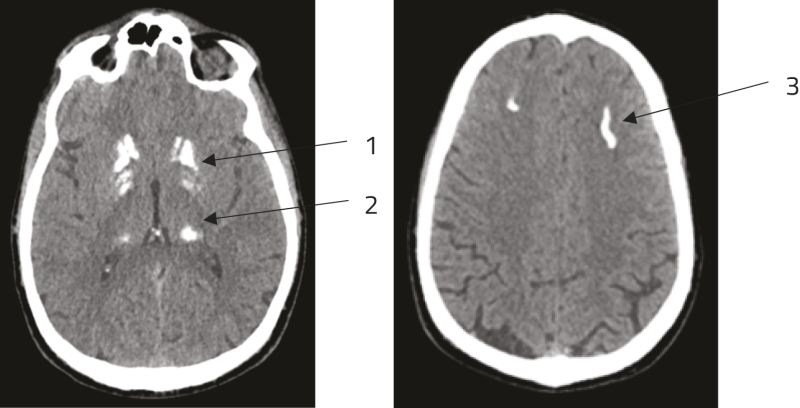
Symmetrical calcifications in the basal ganglia (1), thalami (2) and subcortical white matter, mainly in the frontal lobes (3)
Symptoms
The symptoms vary greatly from person to person.
Some people have extensive calcifications without obvious symptoms, while others develop severe neurological problems.
Possible symptoms include:
- Movement disorders, such as tremors, stiffness, and difficulty walking, or shuffling of the feet and legs
- Difficulty with balance, walking unsteadily or crookedly
- Speech problems such as unclear or slow speech due to difficulty controlling the mouth muscles
- Swallowing problems
- Epileptic seizures
- Fatigue
- Headaches
- Memory- and concentration problems
- Changes in behavior or personality
- Depression, anxiety or psychotic symptoms
Fahr's symptoms may resemble symptoms of Parkinson's disease / Parkinsonism.
The first symptoms often appear between the ages of 30 and 60, but the condition may also manifest at a younger or older age.
Diagnosis
The diagnosis is usually made using a CT scan of the brain. The calcium deposits are clearly visible on a CT scan.
In addition, blood tests may be performed to rule out other causes of brain calcifications.
In some cases, genetic testing is performed to demonstrate a hereditary form.
Treatment
There is currently no treatment that can remove the calcium deposits or cure the disease. Treatment therefore focuses on
reducing symptoms and improving the quality of life.
Examples of treatments include:
- Medication for movement disorders
- Medication for epilepsy when seizures occur
- Treatment of psychiatric complaints such as depression or anxiety
- Physiotherapy, occupational therapy, and speech therapy
Relevant information
Magrinelli.F., et al. Basal ganglia calcification: ‘Fahr’s disease
Peters, M. et al. Mechanisms of in calcification in Fahr's disease and exposure of potential therapeutic targets. Neurology® Clinical Practice Volume 10 • Number 5 • October 2020 Pages: 449-457
- https://www.researchgate.net/publication/381343113_Fahr_Disease_Review_and_case_Report Chen, S.-Y., Ho, C.-J., Lu, Y.-T., Lin, C.-H., Lan, M.-Y., & Tsai, M.-H. (2023). The Genetics of Primary Familial Brain Calcification: A Literature Review. International Journal of Molecular Sciences, 24(13),
10886. https://doi.org/10.3390/ijms241310886
advertisements are not ours