FASD - Foetaal Alcohol Spectrum Disorder
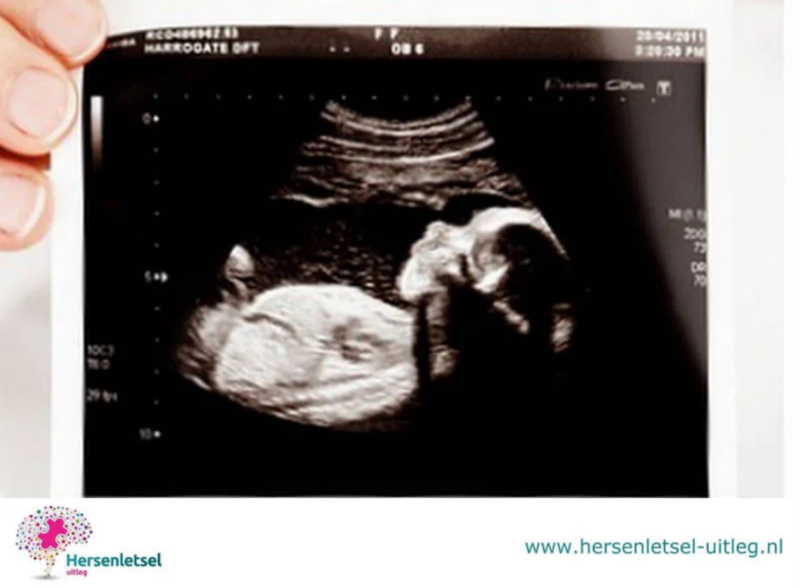
When a pregnant woman drinks alcohol, she risks brain damage and abnormalities in her unborn baby. Alcohol enters the unborn baby's bloodstream via the placenta.
Alcohol is very harmful and damages the developing brain of the fetus. This may lead to premature birth, abnormalities, brain damage, and complications. Various types of abnormalities may occur.
Collectively, these are called Fetal Alcohol Spectrum Disorder or FASD.
These children may have neurological abnormalities, facial abnormalities, behavioral abnormalities and / or delayed growth and are often intellectually impaired and physically impaired.
These limitations also persist into adulthood. Therefore, a person remains limited for life by alcohol consumption during pregnancy.
This damage could have been 100% prevented if the mother had not drunk alcohol. It is best not to consume any alcohol at all during pregnancy (so not even the occasional glass).
Future fathers who regularly and heavily consume alcohol run a significant risk of having a child with FASD. Fathers have a major influence on the mother's health and alcohol consumption. Therefore, it is also important for fathers not to drink alcohol before and during pregnancy.
It happens that women do not know they are pregnant or that alcohol is harmful. These people may carry a great deal of guilt. It is important not to adopt a judgmental attitude.
Fertility and Alcohol
Alcohol negatively affects fertility. This applies to both women and men. It can become more difficult to conceive when people drink. Therefore, the advice for men and women who want to have a child is not to drink alcohol.
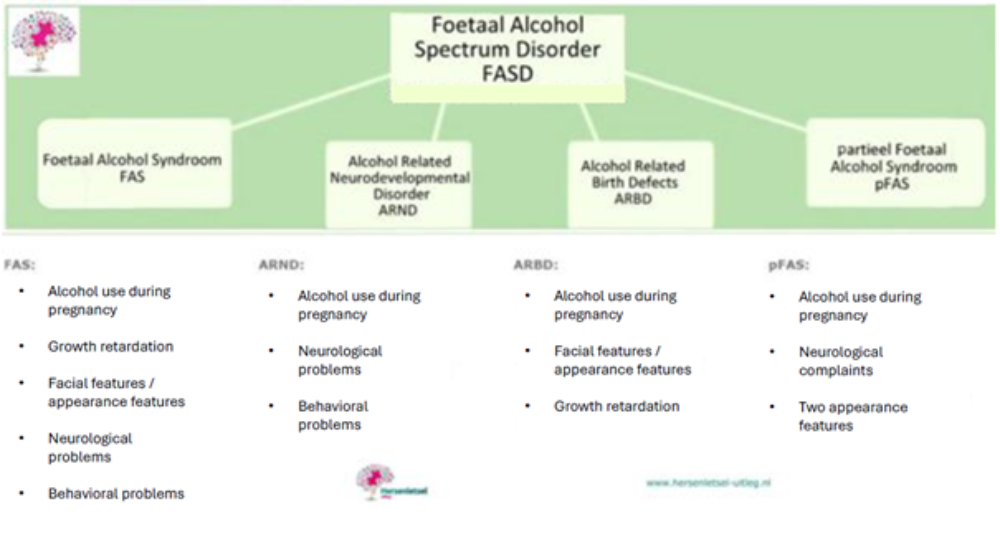
One of the abnormalities within the spectrum is called FAS, or Fetal Alcohol Syndrome. This is the best-known and at the same time the most severe form. It is estimated that it affects 19.8 children per 1,000 births in Europe.
Other abnormalities belonging to the spectrum are the following:
- ARND: Alcohol Related Neurodevelopmental Disorder
with characteristic neurological behavioral problems, no abnormal appearance - ARBD: Alcohol Related Birth Defects
with the typical physical characteristics but not the typical learning and behavioral problems - pFAS: Partial Fetal Alcohol Syndrome
with at least two physical characteristics of FAS and neurological symptoms - FAE: Fetal Alcohol Effects (an outdated term with two of the three main components of FAS)
Overview:
Click to enlarge
Facial features
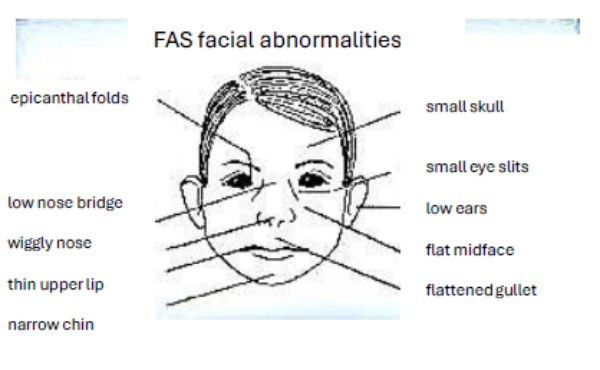
The presence of abnormal facial features does not occur in all affected individuals. It indicates the time at which the child came into contact with alcohol during pregnancy (a short period during which the structure of the face is formed).
The presence or absence of abnormal facial features is independent of the severity of the consequences of FASD.
The physical abnormalities in their face may include: a straight upper lip, a broad nose, drooping eyes, and poor teeth.

Characteristics of FASD at birth
Babies have similar characteristics to varying degrees: low birth weight, facial abnormalities, and neurological and other physical abnormalities.
A complete diagnosis of FAS involves abnormalities in three areas.
In case not all characteristics are found, it is called Fetal Alcohol Spectrum Disorder (FASD).
Possible facial features:
- Flattened face
- Distance between nose and upper lip is greater than in other children and a flat midface
- Straight and narrow upper lip, (almost) no groove between nose and upper lip / flattened philtrum (philtrum reduced)
- Flat nasal bridge, nose that points slightly upward / upturned nose
- An extra fold between nose and eye (epicanthus / epicanthal folds):

- Overhanging eyelids
- Eyes are set slightly further apart
- Eyes appear smaller
- Lower jaw is smaller and shorter than the rest of the face (micrognathia)
- Low-set ears
- Simple ears (particularly the upper part of the ear)
Possible physical abnormalities
- Abnormalities of organs, such as the heart, liver, lungs, kidneys, or reproductive organs
- Deformed fingers, usually a lateral curvature of the little finger towards the ring finger / curved little finger to the side (clinodactyly)

image clinodactyly: see footnootes
Possible neurological abnormalities
- Smaller head circumference (microcephaly)
- The child's brain is smaller and contains fewer grooves
- Epilepsy
Possible problems in early infancy
- Problems with feeding because the baby cannot find the breast or teat or lets go
- Due to low muscle tone, joints can easily become hyperextended
- Sensitivity to stimuli. Provide as much rest as possible
Characteristics of FAS later in life
Physical
- Poor muscle coordination
-
Poor sucking reflex, poor chewing
- Growth retardation, being slender, underweight and smaller than peers
- Cerebral palsy, unilateral loss of strength or loss of control
- Hypersensitivity to sound, light, touch
- Visual problems (seeing)
Cognitive (thinking, learning, etc.)
- Language development problems
- Memory problems
- Learning difficulties and a lower than average IQ
Behavioral characteristics
- Autistic-like features, difficulty making eye contact, need for fixed structure, limited interest in hobbies or toys
- ADHD behavior
- Hyperactivity and being easily startled
- Possible impulsive behavior
- Increased risk of poor social functioning
- Increased risk of addictions
- Increased risk of behavioral problems
- Increased risk of social isolation
Mood
- Mood swings
- Increased risk of depression
Every situation is different. The severity of symptoms may vary. It is important to set clear rules for the child and to enforce those rules properly.
Reward acceptable behavior! Children are sensitive to positive reinforcement rather than constantly hearing disapproval.
Give the child fixed daily routines.
The Fetal Alcohol Syndrome is an irreparable and untreatable condition that a child will have to bear with his or her entire life.
A proper diagnosis, help, and guidance are of great importance.
More information
- A Youtube channel containing a lot of video's on FASD:https://www.youtube.com/channel/UC0HLie6HmtvCXVZGG9ZLFQA
- Book: Ann Streissguth: Fetal Alcohol Syndrome: A guide for Families and Communities
- AlcoholFreePregnancy
- Information on wikipedia
Help for caregivers
- https://nationalfasd.org.uk/learn-more/wellbeing/supporting-a-loved-one/parenting-tips/
- https://fasdunited.org/tools-for-parents-and-caregivers/
- https://www.aap.org/en/
- https://pruewalkerfasd.com/top-5-essential-fasd-resources-for-parents-and-carers/
advertisements are not ours

Resources
Abadir, A. M., & Ickowicz, A. (2016). Fetal alcohol spectrum disorder: reconsidering blame. CMAJ, 188(3), 171-172.
Clinodactyly picture: By TheFrenchTickler1031 - Own work, CC BY-SA 4.0,
https://commons.wikimedia.org/w/index.php?curid=62313675
Eyskens, E., Feenstra, L., Meinders, A. E., Vandenbroucke, J. P., & Van Weel, C. (1997). Codex Medicus (10eed.). Maarssen, Nederland: Elsevier Gezondheidszorg
FAS stichting - Wat is FASD?. Consulted februari 6th 2016 from http://www.fasstichting.nl/wat-is-FASD.php
FAS2025. (z.d.). GConsulted februari 6th 2016 from https://www.fasproject.nl/
Jacobson, J. L., Akkaya-Hocagil, T., Ryan, L. M., Dodge, N. C., Richardson, G. A., Olson, H. C., Coles, C. D., Day,N. L., Cook, R. J., & Jacobson, S. W. (2021). Effects of prenatal alcohol exposure on cognitive and behavioraldevelopment: Findings from a hierarchical meta-analysis of data from six prospective longitudinal U.S. cohorts.Alcoholism, clinical and experimental research, 10.1111/acer.14686. Advance online publication. https://doi.org/10.1111/acer.14686
Hersenletsel uitleg team | Hersenletsel-uitleg.nl. (2015) from
https://www.hersenletsel-uitleg.nl/
Khalifa, N., Magee, T., Shirazi, S., Salman, S., Yang, C. C., & Mela, M. (2021). The neurocognitive profiles ofjustice involved people with foetal alcohol spectrum disorder: A systematic review. Behavioral sciences & thelaw.
Kuks, J. B. M., Snoek, J. W., Oosterhuis, H. G. J. H., & Fock, J. M. (2003).
Klinische neurologie
(15e ed.).Houten, Nederland: Bohn Stafleu van Loghum.
Mamluk, L., Jones, T., Ijaz, S., Edwards, H. B., Savović, J., Leach, V., Moore, T. H. M., Von Hinke, S., Lewis, S. J.,Donovan, J. L., Lawlor, D. A., Davey Smith, G., Fraser, A., & Zuccolo, L. (2020). Evidence of detrimental effectsof prenatal alcohol exposure on offspring birthweight and neurodevelopment from a systematic review of quasi-experimental studies. International Journal of Epidemiology,49 (6), 1972–1995.
https://doi.org/10.1093/ije/dyz272
Streissguth, A. P. (1997). Fetal Alcohol Syndrome: A Guide for Families and Communities (5e ed.). Baltimore,V.S: Paul H. Brookes Pub ZOEK