Is recovery possible?

How long can recovery from a brain injury continue?
Brain injury differs from all other kinds of injury that people can get. The consequences of brain injury are different for every one. Some people have very little consequences. Others loose awareness of being alive.
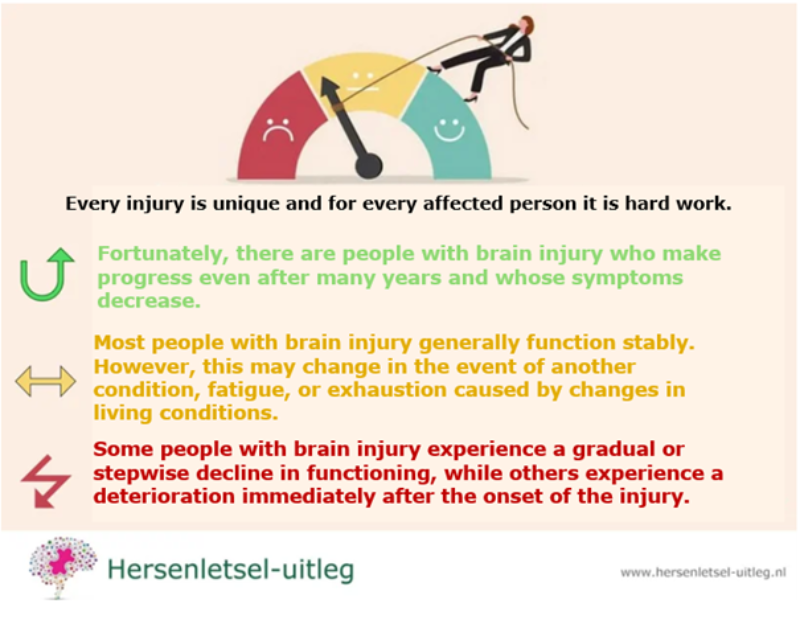
Recovery may continue for a long time, but usually occurs in the first weeks, months, or the first year. Some people recover, but some damage often remains.
Nevertheless, progress can still occur even after years. Fortunately, this is seen often enough!
We know thousands of stories of people who showed forms of recovery after years.
This means that recovery is still possible even after the first year. Do not give up hope! Contrary to what is sometimes said, small improvements can continue for years.
Small improvements in the chronic phase are at least as valuable as the major improvements in the rehabilitation phase.
Every injury is unique.
Does brain injury always have consequences?
We do not know exactly how many people have or do not have residual symptoms. What we do know is that connections in the brain are always damaged and brain cells may die.
A dead brain cell cannot regenerate.
However, in certain brain regions, the brain has the ability to form new connections.
The extent of this influence depends on the location and severity of the injury. A person's general health prior to the injury also plays a role.
What if you don't know if you have sustained a brain injury?
Not everyone knows that she or he has suffered a brain injury! Far from everyone ends up in the hospital after a collision, a fall, assault, a hard blow to the head, or, for example, a severe headache.
Sometimes the GP thinks something else is wrong, or the person her- or himself thinks it isn't that serious.
There are also people who are sent home without a diagnosis after a visit to the Emergency Room, only for it to later turn out that they do have a brain injury.
For people who do receive a diagnosis, it is already difficult to link the consequences to the brain injury. For those without a diagnosis, and without clear physical symptoms, that is almost impossible.
They often get stuck in daily life: at work, at home, or in relationships with family and friends. Time and again, they try to find ways to cope with or compensate for their fatigue, concentration problems, or other symptoms. We have written several pages for them:
- misunderstanding
- invisible consequences
- recognizing brain injury/uneasy feeling
- acquired brain injury checklist
- tools to recognize brain injury
- neurofatigue and burnout

It has been shown that very few people completely recover from brain injury. It is not like a disease for which recovery is possible. ABI professionals (neurologists and neuropsychologists) know all about it. It is also found that recovery can continue for a long time. Years after the injury originated recovery may still occur.
Doctors do not dare make any predictions about the extent to which recovery of brain injury is possible. It is known that the following factors possibly influence the extent to which recovery is possible.
Among neuropsychologists, statements vary depending on their experience with brain injury recovery in their practice. Anyone who has been able to bring someone out of a coma using a stimulation program will cheer and say that 'it is hard work,' but that the person with a brain injury does make progress. However, for many people, maintaining function is also very hard work.
Chronic phase
The chronic phase is the period starting 6 months after the injury occurred.
There are neuropsychologists who see all the misery and sorrow of chronicity in their practice. They see people who work very, very hard, who struggle very hard, but these people are left with the wreckage of their lives and, moreover, are left with a sense of guilt when they read the stories in the media; the success stories of recovery after brain injury.
Who sees their grief, who acknowledges that they too have struggled and tried their best, but did not get any further?
Who heals their wounds? Did they experience a delayed grieving process because they could not accept a changed life sooner? And what about the disappointment of the family of that person with brain injury?
In this phase, and even long afterward, the invisible consequences begin to stand out. Sometimes partners or loved ones notice something and doubt whether it is a permanent change. Arguments can easily arise because someone seems so changed. These can be very small things, such as taking language literally, forgetting errands, appearing to lack stress resilience, or showing no initiative. People then wonder if this complaint could also be a consequence of brain injury. That is indeed possible.
This website was created, among other things, to help people make the connection with the sustained brain injury more quickly.
If someone seems so different than before the stroke, resuscitation, fall, accident, meningitis, or the countless other causes of brain injury, then it is good to read the pages about cognitive consequences, complete a checklist, and read other pages on this website.
Pitfalls and Illness Insight
Someone with a brain injury will always first have to try to learn to recognize and understand the pitfalls before they can regain the strengths they excel at.
These can also be entirely new talents to be discovered, which may make a meaningful life possible.
A pitfall, for example, could be that someone is unable to accurately assess where their boundaries lie, when overstimulation, fatigue, or exhaustion strikes and strikes much harder than when they were still healthy and capable of everything.
It is often said of someone with a brain injury that they lack insight into their illness. The term "insight into illness" is not well chosen, because insight comes through trial and error, often over the years.
After all, no one receives a manual on the invisible consequences upon discharge from the hospital or rehabilitation clinic.
In some injury-related situations, that insight never materializes. These people do not acknowledge that they are ill.
We have written a separate page about this.
Often, gaining insight into one's illness is a diffuse process that can repeatedly bring with it moments of grief.
In the Netherlands, organizations work with the terms 'passer-by', 'seeker', and 'customer'. (developed by Arno Prinsen)
The 'passer-by' experiences no problem or need for help; others are actually bothered by his or her behavior.
The 'seeker' experiences a vague need for help.
A 'customer' knows what the problem is and is willing to work on it. Somewhere between these phases, people can recognize the pitfalls.
Influencing factors
There are many factors that determine how someone recovers, such as the location and severity of the injury. However, how well someone can compensate using other skills or cope with the problem also plays a major role.
What skills does the person still possess? Are important connections in the brain damaged, or can the brain find an alternative route to reach the goal?
Note! None of the following factors is all decisive.
For example, about the third factor (motivation / perseverance) there is a Dutch expression meaning ‘wanting is being able to’.
This expression is not applicable to people having brain injury. Motivation / perseverance alone is not enough and too much of it can cause exhaustion!
Some of the factors are trainable, but many are not.
- Condition of the brain and medical history.
- Has the brain been injured before? Have there been small infarcts?
- Diabetes, high blood pressure, poor blood, poor physical condition: an athlete probably has more chance of recovery than someone who hardly did any sport, excessive alcohol or drug use, had much anesthetic or depression, severe insomnia or lung problems in history.
- Age: the younger you are, the more likely to recover. However, there are reservations here as well, see here.
- Motivation: the will to fight you back. (But what is broken is broken).
- The severity (size and location) of the injury.
- The ability to compensate, for example with intelligence or acquired skills.
- The question whether a brain injury that involves something for which years of training is required. Something that has taken many years to develop will not be repaired in a short time. An example is: speech.
-
Researchers have discovered that someone who sustained a brain injury earlier in life may again experience, among other things, memory and concentration problems that are not solely due to aging. The symptoms they experience resemble symptoms experienced immediately after the brain injury.
This is called the post-ABI effect and is also referred to as the BRAIN-ReADAPT effect.
As people get older, the brain also functions less effectively. However, the brains of people with brain injuries are less able to counteract this. 'It could be due to the fact that the brains of people with brain injuries have to work extra hard because there is damage to the brain.
- For people with a degenerative brain disorder (such as Parkinson's, Alzheimer's, or MS), the future is often marked by uncertainty. These conditions are progressive, which means that the disease can deteriorate slowly, rapidly, or even extremely slowly. Some experience a long stable phase. Nevertheless, every situation is unique, and no one can predict with certainty how the process will develop.
Functional Recovery
Some functions recover more easily than others.
Some functions return because other parts of the brain can take over the work.
In some brain regions, up to 95% of connections can be lost without having much effect on how they function. But if anything more is lost, it can have disastrous consequences. However, there are also functions that can be taken over by other parts.
Difference between Neurogenesis and Neuroplasticity
Neurogenesis refers to the creation of new neurons in the brain. This process occurs primarily in specific areas, such as the hippocampus, which is involved in learning and memory. Neurogenesis is therefore about the growth of new brain cells.
Adults continue to produce new brain cells (neurogenesis), but this process is insufficient to fully repair damage to the brain and the central nervous system (CNS).
Nevertheless, neurogenesis can contribute to initiating the recovery process after a brain injury. Regeneration refers to the regrowth of damaged or lost body parts.
Neuroplasticity relates to the brain's ability to adapt and change, for example by forming new connections between existing neurons. This occurs, for instance, when learning new skills or recovering from brain damage. Neuroplasticity is essentially about adapting and rearranging your brain cells and how they work together.
Brain cells (neurons) and their connections change constantly. This makes it possible to learn new things, remember them, develop new skills, and in some respects, recover from brain injury.
Until recently, it was assumed that the brain developed only during pregnancy, that is, before birth. We now know that new brain cells are constantly being produced by special cells in the ventricles.
New neurons arise during learning and memory development.
A stimulating environment and physical activity can contribute to this process of new neuron production.
In certain brain regions, the brain is able to form new connections between the remaining cells.
This process, also known as neuroplasticity, enables humans to learn, recover from certain brain damage, and develop new skills.
NB!
New brain cells are formed primarily in the temporal lobe and the frontal lobe of the brain. However, no new brain cells are created in the primary visual cortex, the area that processes images.
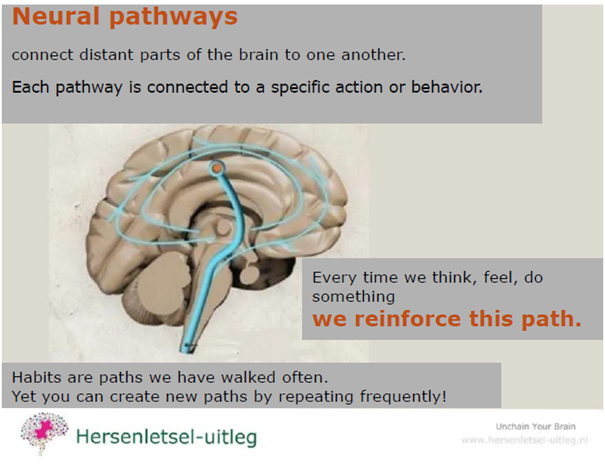
New habits and different thoughts can contribute to quality of life. New thoughts and skills actually pave new paths.
Repetition and practice strengthen these pathways and form new habits. Old pathways are then used less and weaken over time.
Every time we think, feel, or do something, we STRENGTHEN a neural connection.
Limits to neuroplasticity
However, there are limits to the possibilities of neuroplasticity.
Exercising can be beneficial, but realize that there are also limits to what can be regained. Listen to your therapists regarding this.
There is a saying that applies to skills to a certain extent as well: "When you do not use it, you lose it." If you do not use a skill, you can lose it.
Even when the recovery of function comes to an end, many people with injury prove to be creative in shifting their focus to what *is* possible.
TCDS
Research into TCDS (Transcranial Direct Current Stimulation) is currently being conducted in the Netherlands (see here). TCDS is a form of brain stimulation in which brain tissue just below the skull is stimulated by means of electrodes, so that healthy parts of the brain take over tasks from the damaged parts.
At present, the research focuses on motor skills, everything related to a person's movement. In the future, this could potentially be expanded to other brain functions.
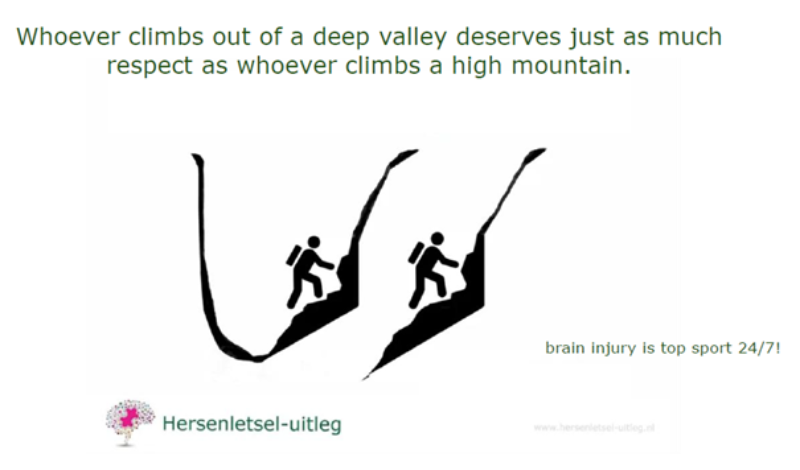
Respect!!
Living with a brain injury is 24/7 top-level sport.

advertisements are not ours