Sensory cortex
and somatosensory cortex
The sensory cortex is an important area in our brain. It is responsible for processing sensory information. This means that it helps interpret signals from our senses, such as sight, hearing, touch, smell and taste.
The sensory cortex is particularly active when, for example, we touch something and feel how it feels or when we look at a beautiful painting. Each sense has its own specific part of the sensory cortex that processes this information, so that we get a clear picture of our environment.
When someone sustains an injury to the sensory cortex, this can have significant consequences. Depending on the location and severity of the injury, the person may have difficulty recognizing sensory stimuli. This can manifest in various ways, such as being unable to feel touch, not recognizing buildings or people or even in hearing problems.
In some cases people may also experience a phenomenon called "sensory hypersensitivity," where normal stimuli are perceived as uncomfortable, overwhelming, or painful.
What is sensory?
Sensory concerns everything we perceive with our senses and how we understand information from our environment.
What is sensorimotor?
The collaboration between sensory perception and motor perception is called sensorimotor. In the M3 (tertiary motor cortex), a choice to move is made.
The secondary motor cortex programs this choice and transmits it to the primary motor cortex, which ensures that the movement is executed.
What is the somatosensory cortex?
The somatosensory cortex is a specific part of the sensory cortex responsible for processing information from the skin, muscles, and joints.
This region is located in the parietal lobe of the brain and plays a crucial role in our sense of touch, temperature detection, and pain perception.

The sensory homunculus
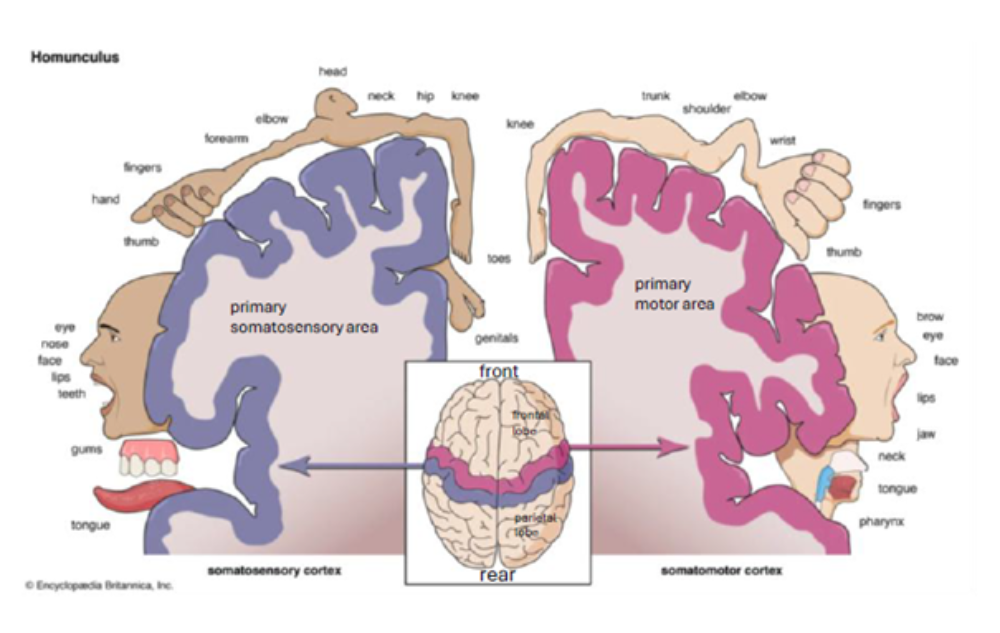
The sensory hominus is a schematic representation of the body parts on the sensory cortex, which is located in the parietal lobe of the brain.
It clearly shows how much brain space is used for the sensitivity of each body part.
This means that some parts of our body, such as the hands and lips, have more space in the brain than others, such as the back or shoulders. They therefore have more sensory nerves (sensory nerve endings). Your lips and fingers are consequently more sensitive than your calf.
For patients, this insight can help in understanding conditions related to pain, numbness, or other sensory disorders. By visualizing how they are affected by their condition, patients can communicate better with healthcare providers and ask fundamental questions about their treatment.
The left sensory cortex reflects what you perceive in terms of sensation or pain in the body areas on the right side of the body. Conversely, the right sensory cortex reflects the body areas on the left side of the body.
advertisements are not ours